
When Elegant Themes launched Divi 5, they didn't release a version update. They rebuilt the entire platform from scratch — new foundation, new visual builder, new performance model, new module system built in React.
For designers and developers who've spent years building with Divi 4, the Divi 5 vs Divi 4 question is a practical one: what actually changed, what stayed the same, and what does it mean for how you work day to day?
This is that answer.
The Core Architectural Shift: Divi 5 vs Divi 4
The most fundamental difference in Divi 5 vs Divi 4 is the rendering architecture.
Divi 4 was built on a PHP-rendered architecture. Changes in the visual builder were processed server-side, rendered back to the browser, and displayed. This created inherent latency — a beat between making a change and seeing it — and placed a ceiling on editor performance.
Divi 5 moves the visual builder to a React-powered frontend architecture. Changes render client-side, in real time, without server round-trips. The editing experience is not incrementally faster than Divi 4 — it is qualitatively different.
For developers building modules and extensions, Divi 5 vs Divi 4 means a fundamentally different technical environment: React and TypeScript on the frontend, PHP handling server-side rendering and data.
Visual Builder: Divi 5 vs Divi 4
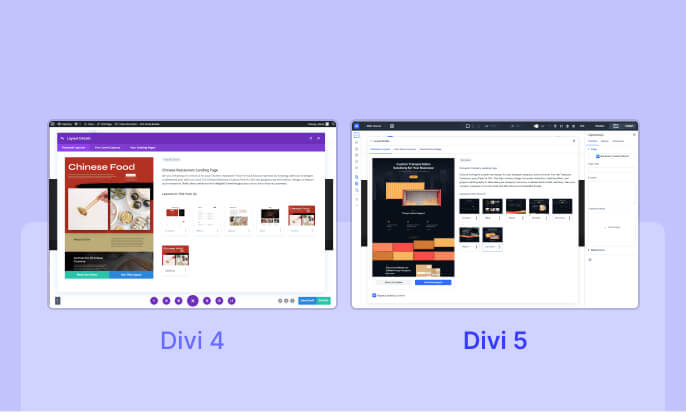
Real-time rendering — the most immediately noticeable difference. In Divi 4, there was always a delay between change and preview. In Divi 5, changes are instantaneous.
Panel structure — Divi 5 settings panels are better organized, with cleaner grouping and a more logical hierarchy than Divi 4. Fewer clicks to find what you need.
Global styles — Divi 5 introduces a more robust global styles system. Design tokens (colors, typography, spacing) defined at a global level apply consistently across all modules — something Divi 4 handled inconsistently.
Responsive breakpoints — responsive behavior in Divi 5 is more reliable and more granular than in Divi 4. Independent controls per breakpoint with more predictable inheritance.
Inline editing — text editing directly on the canvas is more reliable and feature-complete in Divi 5 than it was in Divi 4.
Performance: Divi 5 vs Divi 4
The performance gap between Divi 5 vs Divi 4 is measurable at the code level — not just in marketing claims.
JavaScript payload — Divi 5's React architecture enables better code splitting and lazy loading. Only JavaScript needed for a given page loads on that page. Divi 4 loaded more globally.
HTML output — Divi 4 was known for deeply nested, verbose HTML. Divi 5 produces cleaner, more semantic markup — better for performance and SEO.
CSS generation — Divi 5 generates more targeted CSS, reducing unused styles per page load. Divi 4 generated broader stylesheets.
Core Web Vitals — sites built with Divi 5 consistently score better on Google's Core Web Vitals than equivalent Divi 4 sites, particularly on LCP and CLS.
A Divi 5 site built with the same design as a Divi 4 site will typically load faster, rank better, and convert more — without additional optimization. That's the real-world Divi 5 vs Divi 4 performance difference.
Module System: The Most Important Divi 5 vs Divi 4 Distinction
This is where the Divi 5 vs Divi 4 difference matters most for power users.
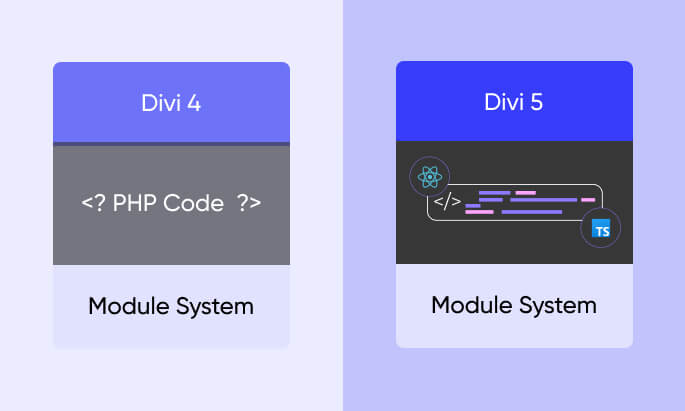
Divi 4 modules were built on PHP architecture using Divi's original module API. Third-party modules extended this same PHP-based system.
When Divi 5 launched with its React architecture, those Divi 4 PHP modules didn't automatically work. A Divi 4 module in a Divi 5 environment either doesn't load, falls back to a compatibility mode, or runs through a bridge layer — negating Divi 5's performance advantages.
True native Divi 5 modules are:
- Built in React/TypeScript for the visual builder frontend
- Integrated natively with Divi 5's settings panel architecture
- Rendering in real time with full visual builder responsiveness
- Generating clean, performant output on the frontend
This is the distinction that matters in the Divi 5 vs Divi 4 module ecosystem: patched vs native.
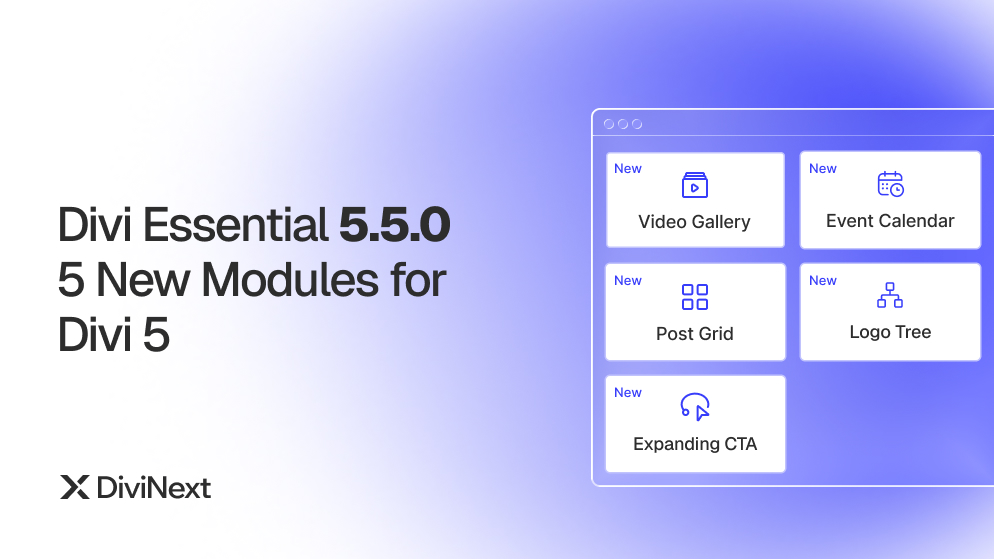
Divi Essential's entire library — 101+ modules — has been rebuilt natively for Divi 5. Not patched, not bridged, not compatibility-mode. Rebuilt from scratch for Divi 5's architecture.
Theme Builder: Divi 5 vs Divi 4
Divi 5's Theme Builder is significantly more capable than Divi 4's in three areas:
Dynamic content — Divi 5 makes it substantially easier to build templates that pull post titles, featured images, custom fields, and taxonomies. Divi 4 required more workarounds for complex dynamic layouts.
Condition logic — display conditions in Divi 5 (show this header on these pages, show this footer for logged-in users) are more powerful and easier to configure than in Divi 4.
Loop builder — building custom post loops in Divi 5 is more flexible than in Divi 4, reducing reliance on custom PHP for dynamic layouts.
What Stayed the Same: Divi 5 vs Divi 4
Not everything changed in Divi 5 vs Divi 4. The conceptual model is consistent:
- Sections, rows, and modules still form the structural building blocks
- The Theme Builder concept (headers, footers, post templates) works the same way
- Global modules still update across all instances
- Divi Library layouts from Divi 4 can generally be imported into Divi 5
- Existing Divi 4 shortcodes still render in Divi 5
The learning curve from Divi 4 to Divi 5 is real but manageable. The architecture is new. The logic is familiar.
Migration: Divi 5 vs Divi 4 in Practice
Migrating an existing Divi 4 site to Divi 5 is not a one-click process.
What transfers cleanly:
- Text content and basic layouts
- Images and media
- Global colors and basic typography
- Most standard module configurations
What needs attention in Divi 5 vs Divi 4 migration:
- Third-party Divi 4 modules that aren't rebuilt natively for Divi 5
- Custom CSS targeting Divi 4's specific HTML structure
- Complex theme builder templates with custom dynamic content
- Integrations relying on Divi 4's PHP hooks
Recommended approach: Build new projects on Divi 5 from day one. Migrate existing Divi 4 sites when a significant redesign is already planned — treating migration as a rebuild produces better results than attempting a direct conversion.
Should You Switch? The Divi 5 vs Divi 4 Decision
New projects: Divi 5, unequivocally. Building on Divi 4 in 2026 means building on a foundation that will need migration later.
Existing Divi 4 sites: Migrate at the next redesign. No urgent reason to migrate a stable, performing Divi 4 site for its own sake.
Developers and agencies: Build Divi 5 expertise now. Client demand for native Divi 5 builds is growing. The tools, modules, and workflows are mature.
FAQ: Divi 5 vs Divi 4 (Quick Answers)
1. What is the main difference between Divi 5 vs Divi 4?
Divi 5 is a complete rebuild with a React-based frontend, while Divi 4 uses PHP server-side rendering.
2. Is Divi 5 faster than Divi 4?
Yes—Divi 5 is significantly faster with better performance and Core Web Vitals.
3. Do Divi 4 modules work in Divi 5?
Not natively—many require compatibility mode or need to be rebuilt.
4. Is migrating from Divi 4 to Divi 5 easy?
No—migration isn’t one-click and often requires manual fixes or a redesign.
5. Should I switch to Divi 5?
Yes for new projects; migrate existing sites during a planned redesign.
Conclusion
Divi 5 vs Divi 4 is not a close comparison in 2026. Divi 5 is a genuine architectural generation ahead — faster, cleaner, more capable, and built for the next decade of WordPress development.
The transition takes intentionality. Native modules, rebuilt workflows, updated design systems. But the result is a meaningfully better platform for everyone building WordPress sites professionally.
DiviNext's full plugin suite — including Divi Essential's 101+ native Divi 5 modules — is fully rebuilt for Divi 5 and available at All Access Pass at an unbeatable price.

0 Comments